

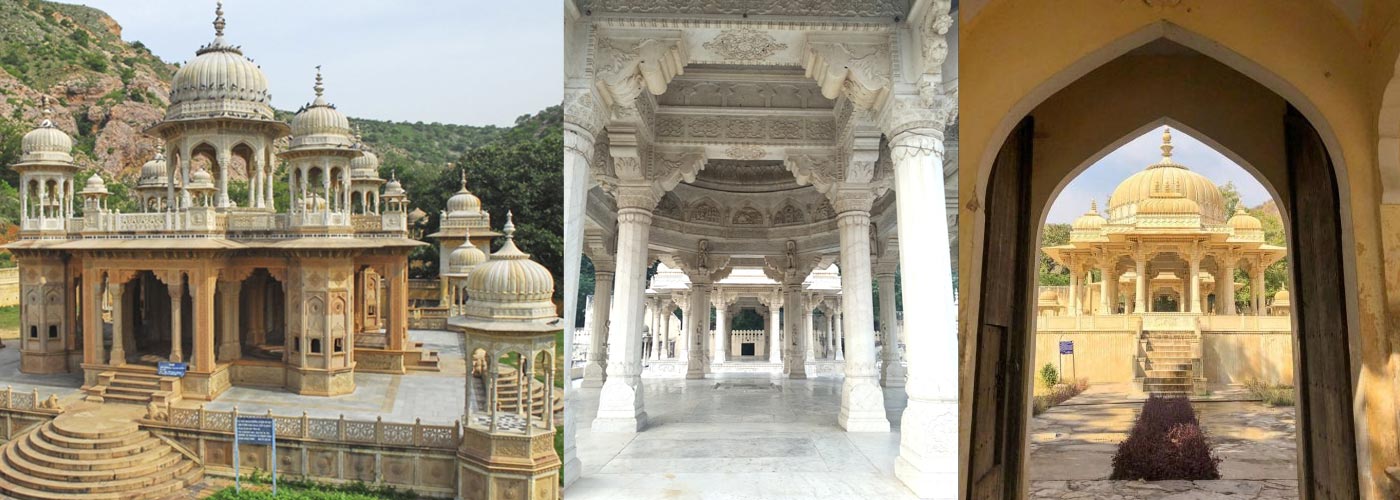
Royal Gaitor is not one of the most prominent tourist attractions in Jaipur; it is one of the city’s hidden gems. I’ve never been able to fully appreciate the reasons for Gaitore travellers’ disinterest. At the end of this article, you’ll read my ideas on why it’s not on the Jaipur sightseeing map. Gaitor Ki Chhatriyan is how the locals refer to this location.
Interestingly, during their travels in the 18th and 19th centuries, a few western travellers recorded visiting Gaitor. John Murray’s “Handbook of the Punjab, Western Rajputana, Kashmir, and Upper Sindh,” published in London in 1883 AD, contains one such trip tale. Edward B. Eastwick wrote this book as a travel guide for western travellers (especially British). It is, in some ways, one of the first travel guides to India, particularly Jaipur.
It’s not unexpected that early Jaipur travelogues identify Royal Gaitor as a location to see in Jaipur. The Royal Gaitor is one of Jaipur’s most stunning architectural works. I’ve gone to Gaitor before, three years ago. This blog, Royal Gaitor | The Rajput Architectural Opulence, has everything!
Because they are Chhatris or tombs of former kings, Gaitor belongs to the descendants of the princely line. This location is divided into three portions, the oldest of which is the furthest from the entrance. It contains the tombs of Maharaja Sawai Jai Singh II, the first king of Jaipur, and Maharaja Sawai Ram Singh II, the second king of Jaipur. Following rulers constructed commemorative Chhatris.